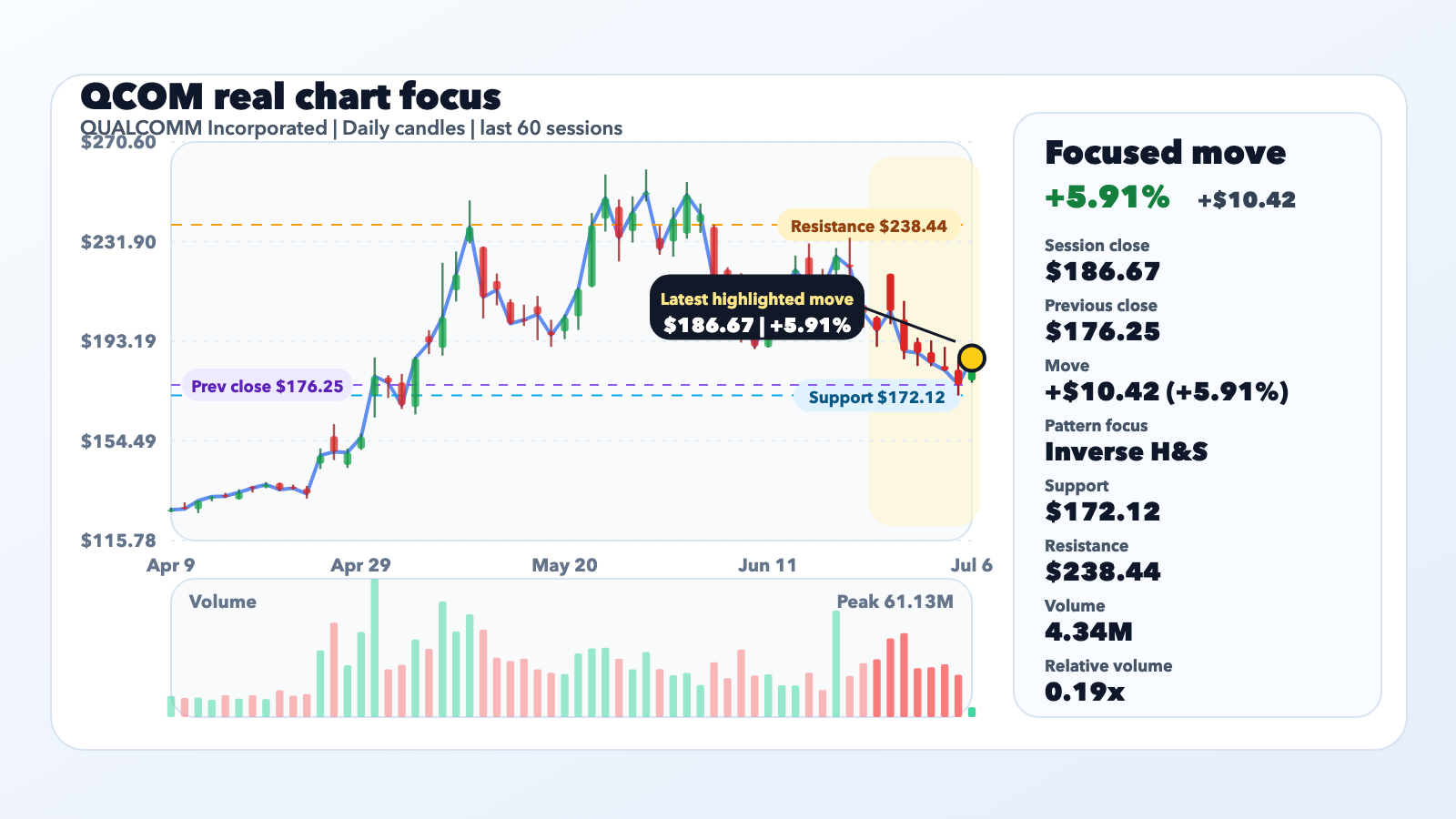
QUALCOMM Incorporated (QCOM) rose 5.91% in the latest session, closing at $186.67 versus $176.25 the previous close. ChartNova's deterministic scan flagged Inverse H&S as the cleanest same-run setup, and the move came with 0.19x of the stock's recent 20-day average volume.
Chart lens
The chart case starts with Inverse H&S. The scanner tagged the stock with an Inverse H&S signal that is directionally aligned with the current move. In practical terms, $172.12 is the support area to watch on pullbacks while $238.44 is the nearest resistance or breakout confirmation zone. The chart/data source for this read is Yahoo Finance chart data consumed through ChartNova's existing pattern vocabulary: https://query1.finance.yahoo.com/v8/finance/chart/QCOM?range=1y&interval=1d&includePrePost=false&events=div,splits.
Catalyst lens
MT Newswires tied the move to "Goldman Sachs Adjusts Price Target on QUALCOMM to $180 From $145", while Insider Monkey independently framed the same move in "Is QUALCOMM, Inc. (QCOM) A Top AI Stock to Buy According to Billionaire Philippe Laffont?". That source trail matters because it lines up with the tape instead of forcing a story onto a random price swing. The combination of a visible catalyst and a chart-confirmable move is what moves this from noise into a publishable stock story.
Why the setup matters
QCOM's rally matters because the move lines up with an Inverse H&S setup on the ChartNova pattern map and same-run source coverage from MT Newswires. The move is not just about today's percentage change; it is about whether the stock can hold the current structure after the catalyst headline cools off. If buyers defend $172.12, the pattern can keep its momentum case. If sellers reclaim the stock below that area, the signal weakens quickly.
Caution
A detected pattern is not a price target and it is not investment advice. Inverse H&S is a structure label, not a guarantee. Traders and investors still need to watch follow-through volume, the next company or macro update, and whether the stock can stay above support or break through resistance after the first reaction fades.